THE MAHAMANTRA MOVEMENT
Hare Krishna Hare Krishna, Krishna Krishna Hare Hare Hare Ram Hare Ram, Ram Ram Hare Hare
Naam or the Mahamantra
Naam means the name of the God and kirtan means to apprise that Name mindfully. Naam kirtan generally refers to the chanting of the 32 syllables of the Hare Krishna Mahamantra.
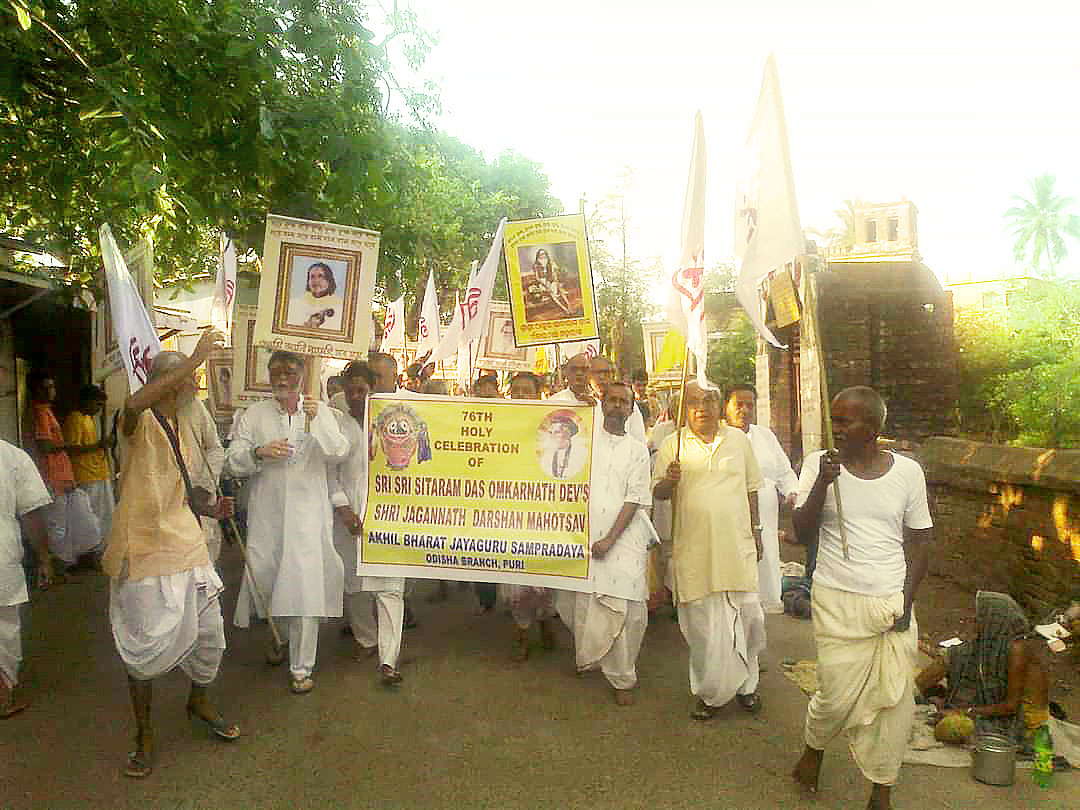
In the recent times, this knowledge of the easiest way to chant and be the one with the God was spread among all by Sri Sri Thakur Sitaramdas Omkarnath. Following His ideals and to humbly carry on His mission of spreading Naam among all humanity, Omkarnath Mission has been set up, with the primary mission to encourage the entire human race to devote at least some portion of their time and energies to this process of listening to and chanting the Name. In this way, they will gradually come to realize that all beings are nothing but an extension of the omnipotent and omniscient and to love or serve anybody in any form is to the serve the Supreme Being.
Naham Vasami Vaikunthe Yoginam Hridaya Na Cha
Mad Bhakta Yatra Gayanti Tatra Tishthami Narada
O Narada, I do not reside in Vaikuntha nor in the hearts of Yogis, but I reside there, where my Bhakta sings my Name.
It is evident from what Lord Vishnu says to Narada, that He can be only found at places where his Bhakta sings his name. We might not know the grammar of singing, might not know right Sur, tone or correct notes, but we all know how to feel with our hearts — to close our eyes and dive deep into the consciousness of our beloved God and then chant His Name as if it is the only thing that can bring to us our most valued gift of life — the association of our beloved Krishna and Ram — then even if storms rise and oceans swell up, time will stand still for us and we will be in union with our dearest forever.
Naam Samkirtan is the only way and not only the one who chants but anyone who hears the chanting or even takes pleasure of the fact that at some place far away from where the chanting is being carried on - all of them dwell in grace.
What is a Mantra?
A mantra is a sacred amalgamation of sounds and letters, resulting in a word or a group of words in Sanskrit. The word mantra, is derived from two Sanskrit roots; manas meaning ‘mind’ and tra meaning ‘tool’. As such, mantras are considered to be “tools for thought” that help in achieving one-pointedness or concentration of the mind with specific focus on the Divine. A mantra is any sound, word or group of words that awaken consciousness by sending divine vibrations through the meaning, tone and rhythm to the mind as well as the body.
What is the Mahamantra?
At the end of the Dvapar yuga (the third out of four yugas, or ages, described in the scriptures of Hinduism), sage Narada approached Brahma and requested him to enlighten him on the path he should follow to alleviate the detrimental effects of Kaliyuga. Brahma replied, by way of chanting the name of the Supreme Lord Narayana, all the tribulations of the Kaliyuga will be washed away. This is the Mahamantra made up of 16 words (shodash mantra) or 32 syllables –
Hare Krishna Hare Krishna, Krishna Krishna Hare Hare
Hare Ram Hare Ram, Ram Ram Hare Hare
(Kali-Santarana Upanishad)
Out of innumerable mantras in the Hindu scriptures, one is revered as the “Mahamantra” (also known as Yuga Mantra or Tarak Mahamantra). Maha – root “mahat”, meaning “great”, literally translated as The Great Mantra.
A mantra is generally chanted with an aim, be it material or spiritual. But as per the shastras there is one mantra, the Mahamantra, when chanted, irrespective of the intent, defies all rituals and delivers both material and spiritual gains. That mantra is the Hare Krishna Mahamantra. Mahamantra chanting results in evoking higher states of consciousness, harnessing the power of intentions, manifestations of positive affirmations and entering deeper states of awareness.
When chanted with devotion, the Mahamantra creates powerful vibrations within the body and mind, enabling deep states of meditation. It has tremendous spiritual and psychological powers. This Mahamantra may either be recited in repetitions as chants or rendered with melody as a song. The latter is more prevalent and advisable.
The meaning of Mahamantra: A divine revelation
In one of his recent discourses in Rishikesh, Kinkar Vitthal Ramanuja Maharaj, the present president of the Jai Guru Sampradaya setup by Thakur Sitaramdas, shared a very simple yet profound explanation of the Hare Krishna Mahamantra.
Mahamantra, he said, is a (shodash) sixteen-words mantra, but essentially it has only three words, 'Hare’, ‘Krishna' and ‘Ram’. These three words, in a specific sequence, get repeated to form a template of 16 words. If one comprehends the meaning of these three words, one can actually understand how the Mahamantra works!
Maharaj explained- the first step in spirituality is removal of sins – harana. Until the paapa is cleansed, removed, rid of, there is no pull towards God. So harana (the word Hare from Hari, connotes harana) is the first step. We keep calling ‘Hare Hare’ and our sins are washed away. Thus, once we are cleansed, we naturally develop an attraction towards God. "Hare" can be interpreted as the vocative form of Hari, another name of Vishnu, meaning "He who removes illusion".
Tripura Devi has explained the meaning of 'Hare' in Radha Tantra as Shiv-Shakti. The 'hra' dhatu stands for ‘haran’ (deliverance); hence the wise define 'Hari' as he who does 'paap haran'. He who unfetters from the burden of sin, blemish, rebirth etc. is 'Hari'.
The second word ‘Krishna’ is rooted in karshan or aakarshan which means attraction. In fact, it is the law of attraction that holds the entire Universe in place. Hare leads us to Krishna, now, we begin to be pulled towards God. This is the next step. Now we cognize God outside of us, in idols, in temples, in holy places, in people, to the extent that we cognize God in the whole world.
But this is not enough! We don’t get complete satisfaction with Hare Krishna as mere attraction isn’t enough. It needs to be manifested in something. That something is still missing.
Krishna Krishna’ leads us to ‘Ram Ram’. This is the final stage of evolution. The word Ram connotes ramana which means to dwell happily, delightfully. When we say ‘Ram Ram’, we realise that the God we were seeking outside is actually residing within us (ramana) and if we could dive within, we could drench in the delight of God who is within us.
Having found God within, the evolution is complete.
So, the Hare Krishna Mahamantra first washes away our sins, then creates in us an attraction to God and finally helps us discover God within ourselves. How beautiful and yet profound meaning! Hence, we can say that the journey of Self Realization is three tiered – Hare Krishna Ram
We can extend the three progressive steps of diksha in our Order to the Mahamantra. The stage before diksha is Ram Naam Likhan, which is Hare stage. Naam Samkirtan is the second stage creating attraction and Mantra Japa helps us delve deep within.
Hare Krishna Mahamantra is universal…. For One and For All
The Mantra that would be most effective in Kaliyuga and could be chanted by one and all, irrespective of their caste, creed, community or religion has been described by Bhagwan Shankar to Mother Parvati in Yoga-Sar Tantra. He says that in Kaliyuga for those who would have faith in the Tantras, the Mantra would be: 'Hare Krishna Hare Krishna Krishna Krishna Hare Hare Hare Rama Hare Rama Rama Rama Hare Hare’.
The Mahamantra can be chanted by anyone, anywhere, anytime.
Unlike all other Vedic mantras, which do not reveal their essence unless numerous rules and regulations are observed concerning preparation, environmental conditions, social circumstances, astrological conjunctions, and so forth, the Mahamantra has no rules concerning who, where, or when it is chanted. This proves that the Mahamantra is liberation which takes us to liberation, the journey and the destination being the same!
Irrespective of ethnicity, age, gender, education, class, and all other worldly designations, as well as all relative degrees of purity or impurity in the environment or the person chanting, anyone and everyone can freely chant the Mahamantra. Furthermore, chanting the Mahamantra, yields a secondary benefit, the results of having performed all varieties of Vedic rites and having chanted all varieties of Vedic mantras.
The Mahamantra is not restricted to Vaishnavism or even to Theism, for that matter. The words Krishna and Ram are universal principles, not just the names of divine personages or Deities.
In fact, the word ‘Hare’ appears first and universalizes the mantra with its all-embracive meaning with harana (deliverance) being comprehensive.
He who does the harana of 'samsara' (worldly existence) is Harinarayan.
He who does harana of ‘ajnana’ (ignorance) is Shiva.
He who does harana of ‘durgati’ (misfortune) is Durga.
He who does harana of ‘vighna’ (obstacle) is Ganesha.
He who does harana of ‘andhakkar’ (darkness) is Surya.
Hare Krishna Naam is for everyone.
Thus, the term 'hare' applies to all the five types of upaasaks (devotees of five principal sects): Shaiva (Shiva), Shaakta (Devi), Gaanapatya (Ganesh), Saura (Surya) and Vaishnava (Vishnu, Ram or Krishna) in their individual sense of the Ishta bhaava (devotion towards chosen Deity).
Mahamantra is the mantra For Kaliyuga
Kaler dosa-nidhe rajann asti hy eko mahan gunah
Kirtanad eva krishnasya mukta-sangah param vrajet
Krite yad dhyayato vishnum tretayam yajato makhaih
Dvapare paricharyayam kalau tad dhari-kirtanat
— Srimad Bhaagvatam 12.3.51-52
In Kaliyuga - which is like an ocean of faults, O king there is certainly one very great quality - Krishna kirtan- that takes you to the ultimate consciousness.
The realization that was achieved in the krta or Satyayuga by meditation, in the Tretā by the performance of different sacrifices, and in the Dvāpara by worship, can be achieved in the Age of Kali simply by Naam Kirtan.
Sri Sitaramdas Omkarnath states
"Whatever is attained in Satyayuga by meditation, in the Treta by sacrifices, in Dwaparyuga by worship, in the Kaliyuga, it can be attained singing Name alone."
"In Kaliyuga, Name is the clear and straight path. Just as all clouds are destroyed by sun's rays and the sun appears, similarly, Name destroys the sixteen varieties of delusion (that is, the imperfections enveloping the soul) and the Paramatma (Lord) appears in person in the heart of the singer.”
In this Kaliyuga, what is that only way, even when followed partially, a person can get full result? That only way is the way of Naam, which alone is capable of taking one to the highest. In this context, it is also relevant to note what Lord Krishna told Arjuna: "O Partha, whoever takes my Name, either with respect or in disdain, his name always remains in my heart." Sri Sri Thakur Sitaramdas Omkarnath elaborates on this note struck by the Lord: "How is it that even if one utters His Name in disdain, his name always remains in my heart?"
While elaborating on this note He says, “Why should it not be so? Material strength is independent of all other forces. Material strength, does not need anyone's faith, respect or bhakti, it exhibits its own power. Name also is like that power. The result of chanting the Name, comes of itself. If you dip your hand even disdainfully in nitric acid, will it not burn your hand?”
If you take poison making light of it, will it not cause death? In the same way, whether you utter Name with respect or love or with disdain, it will be active and produce results. Just as a well is filled up if you go on dropping brick bats in it, similarly, one's heart is filled by constantly singing the Name. "Sing the Name of Hari, Sing the Name of Hari, Sing the Name of Hari"
Sri Sitaramdas Omkarnath on various aspects of chanting Naam or the Mahamantra
Naam or the Mahamantra Naam means the name of the God and kirtan means to apprise that Name mindfully. Naam kirtan generally refers to the chanting of the 32 syllables of the Hare Krishna Mahamantra.
Hare Krishna Hare Krishna, Krishna Krishna Hare Hare
Hare Ram Hare Ram, Ram Ram Hare Hare
Mahamantra Chanting – Underlying Philosophy
In his work Streams of Nectar – Sri Sri Sitaramdas Omkarnath tells us that the foundation of the Universe is Name (Naam). He says:
1. Recite the Name, my mind!
and thou will find peace and conquer death.
From the Name has this universe arisen,
In the Name all objects find their support.
2. The Name objectifies itself into the world,
The Name becomes all forms of life and moves,
As man, woman, bird, beast, worm and insect,
The Name in its myriad forms enjoys its sport,
Manifesting itself as day and as night.
3. As half month and month and the six seasons,
The Name is all: it is the sun, the moon.
The planets: the Name is light and darkness,
The basis of all things is the Name.
It is river, hill and sea, tree and creeper,
Remember Ram, sing Ram, Ram,
And thou wilt attain bliss, о Sitaram!
4. Not a poet's fancy but seeing face to face!
Surely, devotee will meet his Lord.
Unfortunate is the man who keeps away,
Thinking it is all a figment of the brain,
How sweet to hear. Thou Lord! Thy servant I!
5. As thou interest if thou art rid of pain,
Make a firm resolve to see Him face to face.
Without a doubt thou will see Him thus,
Thy heart strings are attuned to the loved Name,
Recite it constantly and move forward.
6. Even now my Lord appears before me,
Recite the Name and make it all in all.
With recitation expectation will arise,
And thou will look out for Him day by day.
7. He, thy life's joy will smilingly appear,
The Lord's servant Sitaram! Recite the Name!
Shabda Brahma- the origination of the Universe
This world is created from Shabda (sound); whatever is visible outside is the manifestation of compact mass of Shabda (sound). Inside, the same Shabda or Naad sports in the form of Paraa in the anal region, Pashyanti in the navel, Madhyama in the heart and Vaikhari in the tongue. This Shabda is indeed God.
Naam- Ekamev Satyam
Everything in this world is asat (unreal), only Naam is sat (real).
There is but one single entity – it is seen as a form with eyes, ears hear it, skin touches
and the tongue tastes it. The entity is but one.
Sri Thakur’s clarion call for Mahamantra
In his work Great Elixir Sri Sitaramdas Omkarnath exhorts us to take to the chanting of Mahamantra as follows:
“Listen. My Name is your support in the journey of life. Sing the Name. Today you are alive, but you will not be alive forever. A day will come when your senses will cease to function and life will leave corporeal frame, and the mortal remains will be either devoured by jackals or burnt to ashes.
If you do not obtain the means of support for the journey, then you are doomed. From this moment - sing the Name; let your whole system utter the words 'Ram Ram' and 'Hari Hari'. This is the best means of leading you to the right path of life. Your wealth, your wife and children will not go with you. While there is still time, sing the Name and obtain what is the worthiest of your while in life. Don't follow too many paths to the higher life, better stick to one - the singing of the Name - this will be the best of your attainments. You need not be proficient in all the scriptures.”
In Hope Abounding, He says:
“Neglect no more, time flies fast. Chant the Name. Practice chanting the Name continuously with each breath. So long as you can utter a syllable, don't give up saying the Name. Heedless of whether you are holy or unholy, ignoring whether you have reverence and faith or not— chant the Name every moment. It is the Name Indeed that will fetch divine love. By silent repetition of the Name, you will see Me face to face. Chant the Name, Chant the Name, Chant the Name, Fear not, Fear not, Fear not.”
"Dearest! Listen, Dearest Mine! To do away with all your pain I have come down as the Name. Take hold of the Name and all your worries shall cease; I Will fill you, within and without, with light and delight. You will be thrilled every moment with My beatific touch, the world won’t flash upon your sight any longer, you will only see blissful Myself. I say on oath, My name can quicken death itself."
The Name and I are not distinct, you know. To say the Name and to stay with me amount to be the same thing. If you chant the Name unceasingly, disease, sorrow, pain and distress will be dancing in your presence assuming the form of bliss. In that great deluge of bliss, the mortal universe will totally dissolve leaving no trace behind; everywhere you will see Myself who am all bliss.”
“Naam-Samkirtan is the smooth, straight and easy way. The luster of My Name goes beyond the Vedas and Vedanta. They become adorable to the three worlds who are immersed constantly in the Name. They themselves can shower grace to rescue numerous sinners and sufferers.”
Mahamantra – The Slayer of Sins and Ignorance
According to the Radhatantra, Mother Parvati gave this Mantra to Bhagwan Vasudeva. “If you ask me, whether by taking Name once, all sins will be burnt to ashes, I reply, that it must happen. Take for example, a huge heap of straw or a large quantity of cotton, wool or a dark cave. Do you require dozens of match boxes to reduce the heap of straw to ashes? No. If you apply even one match stick, it will start burning and gradually the whole heap will burn away. In the same way the heap of cotton or wool will be quickly burnt by the application of one single match stick, it will dispel the century old darkness of the cave immediately. Like a straw heap, the sins of a very sinful person burn slowly. If a man is moderately sinful, his sins are burnt away rapidly. The dark ignorance of the mind of an otherwise virtuous person is immediately dispelled."
No pre-requisites – Just start with the Mahamantra Journey
“The power of my Name does not come from your devotion. As the great fire destroys creation in the hour of dissolution, so does the Fire of my Name consume the sins accumulated through crores and crores of birth. Oh sinner' Here am I — waiting for you. Fear not.”
Sri Sri Thakur professed on innumerable occasions about the efficacy of Naam in this Yuga. In the book, Cloudburst of a Thousand Suns, we find:
1. Hare Krishna Mantra has a foundation in the Vedas, Tantras and Puranas. Sri Mahaprabhu preached this Naam. This is the Naam-deliverer of Kaliyuga.
2. The path of Naam Samkirtana is simple, straight and easily traversed. The splendor of My Name transcends even that of Veda and Vedanta. Those who forever sing the Name of God are equally worshipped in all the three worlds. Their blessing is delivered to the sinful and the afflicted.
3. There’s as much bliss as you sing Naam!
There’s as much bliss as you sing Naam!
There’s as much bliss as you sing Naam!
Hare Krishna Hare Krishna, Krishna Krishna Hare Hare
Hare Ram Hare Ram, Ram Ram Hare Hare
4. If you sing a great deal of Naam, great deal of bliss will come to your lot. There’s as much bliss to be enjoyed as you chant Naam.
5. By singing Naam loudly the birds and the beasts, plants and trees, are all sanctified (by listening to Naam), the Naamkari is also sanctified. There’s one more thing, normally only those who are in close vicinity hear Naam, but by singing it loudly Naam will mix with air and reach those who are even five hundred feet far. It will sanctify the atmosphere, the distant ones will be blessed, and breathing in this charged air, their hearts will be purified.
6. To seek authentic welfare of every devotee, and to bless them, preach the adoption of Tarak Brahma Naam. May it be sung to the accompaniment of khol and kartaal and with dance. That is enough! This alone will manifest the Anahat Naad.
Hare Krishna Hare Krishna, Krishna Krishna Hare Hare
Hare Ram Hare Ram, Ram Ram Hare Hare
Shravan & Kirtan
The root lies in shravana (listening to Naam). The tongue of the sinner is incapable of singing Naam. After having recourse with shravana (listening to Naam) repeatedly, when the sins deplete, then the tongue gains power to sing Naam.
Extremely sinful ones do not even have the fortune of shravana (listening to Naam). These people stay far away from any contact with God. If somehow Naam manages to reach their ears, it attracts them to by dint of its own force.
In shravana (listening to Naam) only shravana is achieved, but in kirtan (singing) you have the benefit of both shravana and kirtana, therefore kirtana is considered superior.
You are listening to God’s lore; if you will remember God while listening to His divine sports, you will gain more joy. To forget Him and to recite things inanely gives no joy.
Mahamantra – The one-stop shop for one and for all!
Naam is definitely a great spiritual practice, but it is not difficult at all. It is something which children, old men, young boys and girls, everyone can do. By adopting Naam, one gets rid of sorrow, disease, distress and suffering. This is a practice that embodies the essence of various sadhanas (spiritual practices).
There is no one who is free from physical or mental disorders. Nor is there anyone who is free from all desires. That is why it is necessary for everyone to repeat ‘Ram’, ‘Ram’. ‘Ram Naam’ means Name of God. Whichever Name (of the deity) has been given by one’s Guru, by repeating that very Name, man succeeds in reaching the destination.
Self-restraint and sacred texts establish a man in supreme bliss. He, who is good for nothing and cannot undertake to purify food habits, cannot seek association of holy men, nor do any worship, the way, even for such a person is ‘Ram Naam’.
Naam and only Naam – That will suffice
People who are capable of chanting Naam continuously need not undertake any other spiritual practice. But how many can be so fortunate? That is the reason Gayatri Japa at the three prescribed hours, japa of the Ishta Mantra and reading of the sacred texts extolling the divine sports, need to be undertaken daily.
Those who take refuge with Naam and try to conduct themselves righteously according to their ability, if they entertain merely the desire: 'I will forever adhere to Naam'; they don’t have to worry about doing anything else. These are the people I hold close to my heart.
The Naam Cannon
Even today a man can attain God by chanting Naam. I don’t say it just once; I avow it a hundred times, a thousand times, a million or zillion times that even now men can see God. It is possible to win His grace by chanting ‘Ram’, ‘Ram’ while sitting and standing, eating and lying down. There is no doubt about this. Those desirous of God’s grace can test this out on their own.
Keep chanting Naam always and blow away the frenzied tensions of the mind, and difficulties (which the scriptures report to) on the path of spirituality, with the help of the Naam-Cannon.
With the cannon of Naam blow away all your deficiencies, disturbances, grief, unhappiness, disease, and distress; carry on unperturbed. Sitting or standing, eating or sleeping, sing Naam– Victory to Naam! Victory to Naam! Charaiva iti charaiva iti – march on; keep moving ahead! Jai Sitaram!
Sing Naam. Naam alone is the great net to catch the prana. By singing Naam a devotee can succeed in taking prana to Prananath (lord of the breath) and make even God his eternal companion.
Once you take refuge with Naam, there is nothing to worry. The waves of the ocean of samsara will settle now.
The Kalpavriksha of our times
Naam is the wish-yielding tree. Whatever you desire of it, you will get it. You will surely get it. If anyone sings Naam with one wish in mind, a hundred are fulfilled!
Are you crying due to the grief, due to lack of food, clothes and money? Sing Naam, sing Naam! Whether you desire it or not, food will be heaped at your doors, you will be able to feed thousands of people. Without seeking it, lots of money will fall at your feet. You will not have to worry about clothes; in fact, you will be able to distribute clothes. Even if you want to renounce, the objects and wealth you are indifferent to, will follow you. I am in no way exaggerating. Should you require proof, come to me I can give you a testimony of this.
Hare Krishna Hare Krishna, Krishna Krishna Hare Hare
Hare Ram Hare Ram, Ram Ram Hare Hare
Keep chanting this Mahamantra continuously. You will not have to worry about anything; God will take care of your entire burden. He will look after all your needs; you will be free of all tensions. Just keep chanting Naam. Don’t let a single breath waste away.
Naam – too profound for mundanity
Repentance, austerities, reading holy texts and giving charity during times beset with difficulties, even these can exhaust one's sins. Therefore, it is inappropriate to take refuge with Naam for the purpose of destroying one's sins. ‘God, be thou pleased with me!’ this is the sentiment a devotee must harbor in mind while adopting Naam. One doesn't need to summon an elephant in rut to kill a mosquito!
It is possible for a supplicant to get the desired object through Naam. But those who sit beneath the wish-yielding tree of Naam and seek worldly pleasures; they are deprived of the ultimate good. Naam satisfies their desires; but it does not reveal its supremely blissful nature of Truth to them.
He who enthrones Naam on the asana (seat) once, doesn’t have to think of anything; the second seat is naturally taken by God. Wealth rolls at the feet of he who sings Naam.
Shastras have proclaimed it loudly – other than the inferior pleasure of the senses, there is a great joy on earth which is sublime and supreme. This very body can experience it; it can be obtained in this Yuga only through chanting of Naam.
How the Name leads to the final goal
1. That out of sound (Shabda) creation emerged is clearly mentioned in the Vedas. In the Shrutis, sound (Shabda) has been called Prana-Spandan or tremor of life. It is from Shabda that all comes.
2. That Shabda Brahma, the Supreme, plays in the human body as Paraa in Muladhar (below the navel region), as Pasyanti at the navel, as Madhyama at the heart and as Vaikhari in the mouth.
3. The key to the secret of creation is found in the words: 'I will be many, I will be born'. The Vaikhari sound, inclined towards creation, moving in the direction of creation, builds up life in the world. Wandering from life to life through a cycle of births and deaths, when at last, man is sick of torment of turning the mind outwards, longs to return to the center of his being, then he has to adopt "Vak" or word in order to return. That is the direction of the shastras. So, you chant the Name with word of the mouth, with the Vaikhari (Vak). When as a result of this chanting, your tongue and throat are gratified, this Vak or word arrives at the heart or Madhyama.
4. At this stage, the body shivers and shakes and numerous other symptoms appear. Gradually, Jyoti and Naad come, transcendental light and sound reveal themselves. When transcendental experiences of sound, touch, sight, taste and smell come, you grow indifferent to the sensuous appeal of the physical sound, touch, taste etc. With the blazing of red, blue, yellow, white and numerous other glaring lights within yourself, you find yourself immersed in a sea of bliss. Several hundred crores of Jyotis are there and several thousand crores of Naad.
5. No one can ever succeed in enumerating all of them. Rumbling of the cloud, the roar of the sea, the hum of bees, the droning of large black bees, the music of the flute, of the lute, of so many other stringed instruments, the sound of drum, of cymbal and so on. And many, many other kinds of Naad are there. It is impossible to draw a complete list, 'Jai Guru' Naad, 'Guru Guru' Naad, 'So-ham' Naad, Om Naad, these are part of one's experience.
6. When the Om Naad goes on continuously and unceasingly without a moment's pause, one has no power stop it or arrest its course. Gradually, one becomes the sound itself, and gets into samadhi.
Sri Ram Ram Ram Likhan
Chanting can be done in many ways and one of the ways of chanting is the Japa - where a count of the mantra is kept either by the fingers or by a Maala. Japa can be of many types mansik (by mind), vachik (by tongue), or likhit (by writing). Manasik and Vachik - we have discussed earlier by way of mahamantra chanting. For likhit japa Sri Sri Thakur Sitaramdas Omkarnath suggested Ram Naam. Lord Ram was his most favorite deity and so he has empowered this likhit japa of Ram Naam so much so that anyone who does it with faith and devotion or even without faith and devotion will achieve whatever she/ he wants.
There is a particular method of writing the name of Ram by prefixing the name of the goddess Sri. Each Sri is followed by three times Ram. Thus, one line contains one Sri and three Ram Naam. Twelve such lines make a para of 36 Ram Naam. 3 such paras make a column of 108 Ram Naam and 3 such columns make a page of 324 Ram Naam. At the end of the page resides a single Sri followed by a single Ram - taking the whole count of the page to 325 Ram Naam.
At the top of the page there resides the Guru himself as Sri Sri Gurave Namah is written there. Each page makes up a book that contains 41,600 Ram Naam. The grand total has to be kept and each book when finished, shall be forwarded to Naam Mandir at Mahamilan Math Kolkata, Sri Ramashram Dumurdaha, Omkar Math, Omkareshwar or Naam Mandir, Rishikesh. A special temple has been built to store Ram Naam at Digsui, the village of the Sri Param Gurudeva (Guru of Sri Sri Thakur Sitaramdas Omkarnath). It is by the power of Sri Sri Thakur — whoever writes the Name of Ram in the manner suggested by Him, shall certainly obtain whatever he desires. Whatever that desire may be, recovery from incurable disease, pleasures of the world, knowledge and bliss, or whatever else may be desired by the bhakta.
Though Thakur held the 32 syllabled Hare Krishna Mahamantra very dear to him, he did not limit us from chanting any name of our choice - He Himself may have shifted to different names as per his different bhavas but when it comes to the writing of the Name, he insisted on one and only one: the name of Ram. For the purpose of writing, no other form of Name will do. In this regard, He strictly followed the guidelines of the Shastras and explained all of it in a booklet titled, "Sri Sri Ram Naam Likhan Mahima" "(The supreme efficacy of writing the Name of Ram)
Sri Sri Gurave Namah
Bhagavatbigreheshu,
Please accept my humble obeisance,
All glories to Sri Sri Thakur Sitaramdas Omkarnath!
About the Mahamantra Movement
Welcome to the Mahamantra Movement group that has been started by the Omkarnath Mission.
Our target audiences are those seekers who are already doing Japa every day, but wish to increase the quality of their Japa.
This is a module which strictly follows the directions given by Sri Sri Thakur for the wellbeing of His disciples. Omkarnath Mission plans to post such 108 modules in the next one year. The modules will be designed almost like a course on basic concepts of mindful purposive Japa and hence it would benefit members to stay with the flow that builds up concept by concept systematically over the next one-year period.
The Movement will function through WhatsApp.
FAQs
1.
Who can join this group? Any devotee who has started chanting Japa and who is acquainted with Sri Sri Thakur’s books and other spiritual literature or devotees who do one or two rounds of Japa daily, provided they want to take up chanting 16 rounds daily, eventually.
2.
Where should I post the questions? Post your questions to Kinkar Sujayananda who will be the admin for this group and can be reached on +91 9330507362. Please keep the questions short and crisp. Omkarnath Mission will forward those to His Holiness Kinkar Vitthal Ramanuja Maharaj. His answers will be posted along with the questions in another group called Mahamantra Movement Q&A. Please join that group too. Names of devotees asking questions will be withheld and only questions will appear with answers.
3.
What kind of questions can be asked? * Questions relating only to Japa will be answered. Please note, mundane/ materialistic questions will not be entertained at all on this platform.
* Questions seeking further clarity on writings by His Holiness Kinkar Vitthal Ramanuja Maharaj.
* Questions relating to overcoming challenges faced during Japa.
* In case of general & scattered questions on Japa, answers will be included in those modules in the future that are relevant to the question.
4.
Will there be any feedback mechanism? The Mission may seek feedbacks from the participants of the group. The sole purpose will be to know how the movement is helping you in your journey of Naam. Suggestions for any improvements in the overall learnings of the group might also be sought. Feedbacks will be replied by His Holiness Kinkar Vitthal Ramanuja Maharaj on an individual level. This is a great way to have a direct connection with Him on the progress and improvements in your Japa.
5.
Can direct questions be asked to Kinkar Vitthal Ramanuja Maharaj for personal spiritual guidance? Yes, however, patience is must to get the answers as He will answer the questions as per His convenience. His first priority however, will be to answer the questions in the group, as that will reach and benefit a larger number of devotees.
6.
Can invites be sent to new joiners at any stage? Yes, a devotee can join the group at any stage since all the completed modules will be available for study in the group. However, a new joiner will be required to complete all the past modules to keep up with the present level and progress of the group.
Scriptural References
Following are the Scriptural references for Hare Krishna Mahamantra:
1. The sixteen names of the Hare Krishna maha-mantra: Hare Krishna Hare Krishna Krishna Krishna Hare Hare, Hare Rama Hare Rama Rama Rama Hare Hare destroy all the inauspiciousness of the age of Kali. This is the conclusion of all the Vedas. (Kali-santarana Upanisad from Krishna Yajur Veda)
2. All the grievous sins are removed for one who worships Lord Hari, the Lord of all Lords, and chants the holy Name, the Mahamantra. (Padma Purana, 3.50.6)
3. This 32-lettered Hari Nama Mantra protects in the Yuga of Kali. (Radha Tantra, 29,30)
4. “O my son, I will certainly instruct you in that maha-mantra, the acceptance of which a person in the bodily conception of life can be liberated and even a drunkard can quickly become purified and attain all perfection. I will instruct you because you are a mahabhagavata and a suitable candidate. Just see! The sixteen word maha-mantra, Hare Krishna Hare Krishna Krishna Krishna Hare Hare, Hare Rama Hare Rama Rama Rama Hare Hare, can destroy the sins of the three worlds. The four Vedas do not mention a method for achieving liberation from material bondage superior to the chanting of this mahā-mantra.” (Rādhā Hṛdya Khaṇḍa of the Brahmāṇḍa Purāṇa)
5. When the sixteen names and thirty-two syllables of the Hare Krishna mantra are loudly vibrated, Krishna dances on one’s tongue (Stava-mala-vidyabhusana-bhasya, Baladeva Vidyabhushana in Bhaktisiddhanta’s Gaudiya Kanthahara 17:30)
6. One who chants the holy name of the Lord is immediately freed from the reactions of unlimited sins, even if he chants indirectly (to indicate something else), jokingly, for musical entertainment, or even neglectfully. This is accepted by all the learned scholars of the scriptures. (Srimad-Bhagavatam, 6.2.14)
7. The Naam Samkirtana (public chanting) of Hare Krishna Mahamantra delivers a complete revelation of all of spiritual reality. (Brahmanda Purana 6.59-60)
8. My dear King, although Kaliyuga is an ocean of faults, there is still one good quality about this age: Simply by chanting the Hare Krishna Mahamantra, one can become free from material bondage and be promoted to the transcendental kingdom. (Srimad Bhagavatam – 12.3.51)
9. Whoever chants this mantra, even neglectfully, will attain the supreme goal of life. Of this there is no doubt. (Agni Purana)
10. The nama sankirtana (public chanting) of Hare Krishna maha-mantra delivers a complete revelation of all of spiritual reality. (Brahmanda Purana 6.59-60)
11. “Hare Krishna Hare Krishna Krishna Krishna Hare Hare, Hare Rama Hare Rama Rama Rama Hare Hare: This sixteen-name, thirty-two syllable mantra is the maha-mantra in the age of Kali by which all living beings can be delivered. One should never abandon chanting this maha-mantra and take to other so-called purificatory processes which are practiced by rascals, or engage in chanting other metrical compositions of the name of Krishna that are against the pure conclusions of the scriptures, or are filled with rasabhasa. About this divinely spiritual maha-mantra, which delivers one from material existence, the original guru, Lord Brahma, has said, kali-santararadi srutite, “The srutis have declared this mantra to be the best means of deliverance in the age of Kali”. Having all heard this from Brahma, the sons and disciples of Brahma, beginning with Narada, all accepted the Hare Krishna maha-mantra and, having meditated on it, attained perfection.” Ananta-samhita (which is part of the Narada Pancharatra)
12. “Compared to that person who is attached to chanting japa, the person who performs loud chanting of the holy name of Sri Hari is one hundred times better. This is because the person who chants japa purifies himself, whereas the person who chants the holy name loudly in kirtana purifies himself, all those who are with him, and everyone else who hear the holy vibration.”
(Naradiya Purana, Prahlada-vakya)
13. “He Mahādevī! Look! In Kali-yuga there is no easier way to eradicate sins than by Śrī Hari-Nāma. It is therefore essential to propagate Śrī Hari-Nāma among the general populous. The people in Kaliyuga can be easily liberated from the greatest hell by performing saṅkīrtana of this mahā-mantra. To chant the mahā-mantra, first chant hare kṛṣṇa twice, then chant kṛṣṇa twice, then hare twice. After that, chant hare rāma twice, then rāma twice and again hare twice. One should chant, articulate and perform sankīrtana etc., of Śrī Kṛṣṇa’s mahā-mantra, which destroys all sins.” (Brahma Yāmala)
14. "All shastras agree that the Hare Krishna mahamantra, which is composed of sixteen names and thirty-two syllables, is the illustrious mantra to deliver the jovas in Kali-yuga. Those who neglect this maha-mantra and accept any other process, due to their own imagination or the imagination of others, are actually disobeying guru and shastra. If someone asks, 'Why is this sixteen word Hare Krishna mantra the maha-mantra?' then the following answer is given.
'Among all of Krishna's names' no name other than Hari can easily take away sins, great misfortune and ignorance. No name other than Krishna can deliver prema. And no name other than Rama can bestow liberation.' This is why the maha-mantra is composed of these three primary names. Secondly, these sixteen names are an invocation. Om, namah, klim, svaha, etc., are not required to make the mantra more potent. For this reason it is called the maha-mantra." (Ananta Saṁhitā)
Hare Krishna Hare Krishna, Krishna Krishna Hare Hare
Hare Ram Hare Ram, Ram Ram Hare Hare